
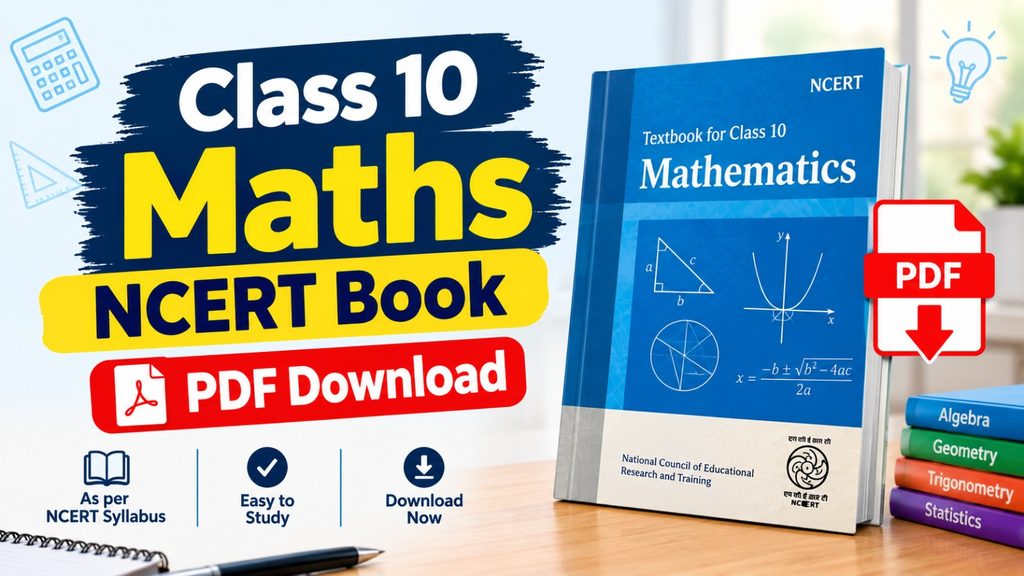
Are you searching for the Class 10th Maths NCERT Book PDF Download? If yes, you have reached the right place. Mathematics is one of the most important subjects in Class 10, and having the correct NCERT textbook available on your phone, laptop, tablet, or computer can make daily study much easier. Instead of carrying a physical textbook everywhere, students can keep the digital version ready and study whenever they have free time. The NCERT Mathematics textbook is particularly important for students following the CBSE curriculum because it builds the fundamental concepts required for school examinations and further studies.
The NCERT Class 10th Maths Book PDF is useful not only for reading theory but also for practising examples, exercises, formulas, and different types of mathematical problems. Whether you are preparing for your school tests, periodic assessments, pre-board examinations, or board-level preparation, the NCERT textbook should be one of the first resources you study. The official NCERT PDF currently identifies the book as Mathematics – Textbook for Class X. Students should always prefer an official or properly verified edition so that they do not accidentally prepare from an outdated or modified textbook.
This page provides complete information about downloading and using the Class 10th Mathematics NCERT Book PDF, its chapters, benefits, preparation strategies, and frequently asked questions. You can also use the download section below to access the textbook.
📥 Class 10th Maths NCERT Book PDF Download
Students who want to study Mathematics digitally can access the official textbook through NCERT. The digital format is particularly useful when you need quick access to a chapter while travelling, revising, attending an online class, or studying away from your physical books. Once the PDF has been saved to your device, you can open it whenever required without repeatedly searching for the textbook online.
📘 DOWNLOAD PDF – Class 10th Maths NCERT Book
Book Name: NCERT Mathematics Textbook for Class X
Class: 10th
Subject: Mathematics
Publisher: NCERT
Format: PDF
Language: English
Download: Official NCERT Textbook
⬇️ DOWNLOAD CLASS 10th MATHS NCERT BOOK PDF
For the safest and most current copy, students should use the official NCERT textbook portal. NCERT provides textbook PDFs for Classes I–XII and includes chapter-level access as well as complete-book download options for supported textbooks.
Why Download the Class 10th Maths NCERT Book PDF?
Downloading the Class 10 Maths NCERT Book PDF gives students flexibility that a physical textbook alone cannot always provide. Imagine that you are travelling and suddenly want to revise quadratic equations or trigonometry. Carrying a large stack of textbooks may not be practical, but a PDF stored on your smartphone is available instantly. This convenience is one of the biggest reasons students increasingly keep digital copies of their NCERT books alongside physical books.
Another important benefit is accessibility. You can open the textbook on different devices, zoom difficult diagrams, quickly move between chapters, and maintain access to study material while attending online classes. Students who prefer physical books can still use the PDF as a backup rather than as a replacement. For example, if you forget your textbook at school or coaching, the PDF can save an entire study session.
A digital NCERT book can also be useful during revision. Instead of searching through several notebooks to find the original question, you can return directly to the relevant NCERT chapter and check the concept, example, or exercise. This makes the NCERT Class 10 Maths PDF a simple but valuable addition to your study resources.
About the NCERT Class 10 Mathematics Book
The NCERT Mathematics textbook is designed to develop mathematical understanding rather than encouraging students to simply memorise formulas. Mathematics becomes much easier when you understand why a formula works, where it can be applied, and how one concept connects with another. This is why students should read the explanations and solved examples instead of immediately jumping to exercise answers.
The book covers major areas of secondary-school mathematics, including number systems, algebra, geometry, coordinate geometry, trigonometry, mensuration, statistics, and probability. Together, these areas build a foundation that remains useful when students move to higher classes. A learner who develops strong algebra and geometry concepts in Class 10, for example, is generally better prepared to understand more advanced mathematical ideas later.
NCERT’s broader vision for school mathematics emphasizes meaningful problem solving, reasoning, abstraction, representation, and developing students’ ability to use mathematical concepts rather than viewing mathematics as only formulas and mechanical procedures. That philosophy is one reason students should approach the textbook conceptually instead of treating every chapter as a collection of questions to memorise.
Class 10 Maths NCERT Book Chapter-Wise Overview
The Class 10 Maths NCERT textbook covers several interconnected mathematical areas. Students should study the chapters systematically because concepts learned in one part of the book often help in another. Algebra strengthens equation-solving skills, geometry develops logical thinking, and trigonometry teaches students how mathematical relationships can be used to solve practical problems involving distances and heights.
While preparing from a PDF, create a chapter-wise study routine. Finish the concepts first, solve the worked examples yourself, and then attempt the exercises without looking at solutions. Mark questions you cannot solve and return to them after revising the concept. This simple process can turn the NCERT book from a reading resource into a complete practice tool.
Chapter 1 – Real Numbers
Real Numbers builds an important foundation for Class 10 Mathematics. Students work with fundamental properties of numbers and learn concepts that support later algebraic reasoning. Instead of treating the chapter as an easy opening unit, students should pay close attention to the logic behind each result. Number-based questions can appear simple on the surface but often test whether a student understands the underlying concept.
When preparing this chapter, write every important result in a separate formula or concept notebook. Solve the NCERT examples without looking at the final steps and compare your method afterward. This habit trains your mind to solve rather than copy. Real Numbers can also be a good chapter for building confidence at the beginning of your preparation because regular practice quickly improves accuracy.
Chapter 2 – Polynomials
Polynomials introduce students to an essential part of algebra. A polynomial may initially look like a collection of variables, powers, and coefficients, but understanding its structure makes later questions far easier. Students should learn the important terminology and relationships rather than simply memorising procedures. If the fundamentals are clear, many polynomial questions become systematic.
Use the Class 10 Maths NCERT PDF to revise worked examples repeatedly. First understand what the example is demonstrating, close the solution, and then solve the question independently. Whenever you make an error, identify whether it came from a concept, sign, calculation, or formula. This error-analysis approach is far more effective than solving dozens of questions without checking why mistakes occur.
Chapter 3 – Pair of Linear Equations in Two Variables
This chapter teaches students how two related equations can be studied and solved. The topic is important because it combines algebraic understanding with interpretation. Students often know individual methods but become confused when deciding which approach should be used for a particular question. The solution is not more memorisation; it is more structured practice.
While studying, create a small comparison chart for the methods you learn and write one example beside each method. Then practise identifying the suitable method before actually solving a question. This builds decision-making ability, which becomes especially useful in timed examinations. NCERT examples and exercises provide a strong starting point for developing this skill.
Chapter 4 – Quadratic Equations
Quadratic Equations are an important part of Class 10 algebra and deserve careful preparation. Students should first become comfortable recognising the standard form of a quadratic equation and understanding the different ideas used to find its roots. Formula memorisation alone is not enough because questions can present the same concept in different forms.
The best preparation strategy is to solve questions step by step while maintaining neat calculations. A small sign error can change the complete answer, so accuracy matters as much as conceptual knowledge. After finishing NCERT examples, attempt the exercises without referring to solutions. Keep a separate list of mistakes and solve those questions again after a few days.
Chapter 5 – Arithmetic Progressions
Arithmetic Progressions show how mathematical patterns can be described systematically. Once students understand the idea behind a sequence and the relationship between its terms, the formulas become much easier to remember. Instead of starting with formula memorisation, write a few simple number patterns yourself and identify how each term changes.
Word problems deserve special attention in this chapter. Read each question slowly and identify the information given before substituting values into a formula. Students often lose marks not because the mathematics is difficult but because they misunderstand what the question is asking. Regular practice from the NCERT textbook helps develop this interpretation skill.
Chapter 6 – Triangles
Triangles connect geometry with logical reasoning. Students need to understand similarity and related geometrical relationships rather than simply memorising statements. Draw figures whenever possible because a clear diagram can make a complicated-looking question much easier to understand. Label every known measurement or relationship before beginning the solution.
Geometry answers should also be written logically. Every major step should have a mathematical reason behind it. Practising NCERT questions helps students become familiar with the expected sequence of reasoning. If a theorem feels difficult, try explaining it aloud in your own words before attempting questions based on it.
Chapter 7 – Coordinate Geometry
Coordinate Geometry creates a bridge between algebra and geometry. Points, coordinates, distances, and geometric relationships can be studied using numerical methods, which makes this chapter particularly interesting. Students should become comfortable reading coordinates accurately and drawing rough diagrams whenever necessary.
Formula knowledge is important, but correct substitution is equally important. Always identify the coordinates carefully before inserting values. If negative coordinates are involved, use brackets to reduce sign errors. Repeated NCERT practice can help students develop the accuracy needed to score well in coordinate-based questions.
Chapter 8 – Introduction to Trigonometry
Trigonometry is one of the topics that students sometimes fear before they actually understand it. Once the fundamental ratios and their relationships become clear, however, the chapter becomes much more manageable. Think of trigonometry as a language used to describe relationships between the sides and angles of triangles.
Do not try to memorise everything in a single sitting. Learn the fundamental ratios, understand how they are derived, and practise them daily. Keep a compact trigonometry revision sheet and rewrite important relationships from memory. Frequent short revision sessions generally work better than trying to relearn the entire chapter immediately before an examination.
Chapter 9 – Some Applications of Trigonometry
This chapter demonstrates how trigonometric ideas can be connected with practical situations. Questions may involve heights, distances, viewing angles, or diagrams that require students to convert written information into mathematical relationships. The real challenge is often creating the correct diagram.
When solving an application-based question, draw the figure first and label everything provided. Then identify what you need to calculate. Only after these steps should you choose the appropriate trigonometric relationship. This habit prevents students from randomly applying formulas and makes longer questions much easier to manage.
Chapter 10 – Circles
Circles require students to combine geometric understanding with careful reasoning. A diagram can make the difference between confusion and clarity, so never hesitate to redraw a figure neatly. Identify the centre, radius, tangent, point of contact, and other relevant elements before starting the solution.
Students should focus on understanding why a property works instead of memorising isolated statements. Once the geometry becomes visual, many problems become predictable. Solve the NCERT examples first and then attempt exercise questions without assistance. If a question seems difficult, redraw the diagram rather than immediately checking the answer.
Chapter 11 – Areas Related to Circles
Areas Related to Circles combines geometry and mensuration. Students need to understand which portion of a figure is actually being measured. A complicated diagram may simply be a combination or subtraction of familiar shapes, so break it into smaller components.
Write the required formula before substituting values. This makes your solution easier to check and reduces accidental mistakes. Units are also important; an otherwise correct calculation can become incomplete if the final unit is missing or inappropriate. NCERT exercises are useful for practising different arrangements of circle-related figures.
Chapter 12 – Surface Areas and Volumes
Surface Areas and Volumes brings together multiple three-dimensional shapes and requires careful interpretation. Students may need to work with combinations of solids, so visualisation becomes especially important. Draw a rough figure, mark dimensions, and decide which surfaces are included before calculating anything.
Many errors in mensuration come from using the wrong radius, height, or formula. Keep a formula sheet but make sure you understand the meaning of each measurement. Practise unit conversion as well because dimensions must be consistent before they are substituted. A systematic approach can make this chapter highly scoring.
Chapter 13 – Statistics
Statistics teaches students how numerical information can be organised and interpreted. The calculations may involve several steps, which means neat tabular working is extremely useful. Students should understand what each quantity represents instead of performing calculations mechanically.
When practising from NCERT, create tables carefully and check every entry before moving to the next step. A single incorrect value can affect the final answer. Statistics becomes much easier when calculations are arranged systematically. Practice also improves speed, which is useful during board-style examinations.
Chapter 14 – Probability
Probability introduces students to mathematical reasoning about possible outcomes. The basic ideas are usually easy to understand, but questions still require careful reading. Students should clearly identify the total possible outcomes and the outcomes relevant to the event being considered.
Avoid rushing through apparently easy questions. Write the information first and then apply the probability relationship. Practise a variety of NCERT problems so that different situations become familiar. This chapter is an excellent example of how understanding a simple core idea can make many different questions manageable.
Why NCERT Mathematics Is Important for Class 10 Students
The NCERT Mathematics textbook gives students a structured path from fundamental ideas to progressively more challenging applications. That matters because Mathematics is cumulative. If your foundation in algebra, geometry, or trigonometry is weak, later questions can feel like trying to build the second floor of a house before finishing the ground floor.
Students should therefore use NCERT as a core learning resource instead of treating it as a book to be opened only before examinations. Read concepts, understand solved examples, practise exercises, and revisit difficult questions. Supplementary question banks can be useful after this stage, but additional resources work best when your fundamentals are already strong.
How to Download Class 10 Maths NCERT Book PDF
Downloading the textbook from the official NCERT platform is straightforward. Visit the NCERT textbook section, select the appropriate Class, Subject, and Book Title, and then choose the available chapter or complete-book download option. Save the PDF in a clearly named folder such as “Class 10 Maths NCERT” so you can locate it quickly later.
Students should avoid random websites that present modified or old files as current NCERT textbooks. Curriculum and rationalised content can change, so using an official source reduces the risk of preparing unnecessary or outdated material. When in doubt, compare your PDF with the version currently displayed on NCERT’s official textbook portal.
How to Study Mathematics Using the NCERT PDF
A PDF becomes useful only when you use it actively. Simply scrolling through chapters will not improve Mathematics. Keep a notebook beside you, read a concept, close or minimise the PDF, and try to reproduce the key idea yourself. Then solve the corresponding examples without looking at the printed solution.
A productive routine can be divided into three stages: learn, practise, and revise. During the learning stage, understand the concept and formulas. During practice, solve questions independently and mark difficult ones. During revision, return specifically to those marked problems and your mistake notebook. This creates a feedback loop that gradually turns weak topics into strong ones.
NCERT PDF vs Physical Book
| Feature | NCERT Maths PDF | Physical NCERT Book |
| Portability | Excellent | Moderate |
| Access on Phone | Yes | No |
| Offline Use | Yes, after saving | Yes |
| Zoom Diagrams | Yes | No |
| Writing Directly on Page | Device-dependent | Easy |
| Best for Long Study Sessions | Good | Excellent |
| Best for Quick Revision | Excellent | Good |
| Backup Study Resource | Excellent | Not applicable |
There is no need to choose only one format. A physical book is often comfortable for long study sessions, while the NCERT Class 10 Maths PDF is excellent for quick access and revision. Using both gives students the advantages of each format.
Class 10 Maths Preparation Tips
Start preparation early and make consistency your priority. Mathematics is similar to physical exercise: practising for several hours once a month cannot replace regular training. Even a focused daily session can produce significant improvement when maintained over time. Divide your syllabus into manageable portions and set realistic weekly targets.
Maintain a formula notebook and a separate error notebook. Every time you make a mistake, write down the question type and the reason for the error. Was the formula wrong? Did you misunderstand the question? Was it a calculation mistake? When you identify the cause, you can prevent the same mistake from appearing repeatedly.
Also practise writing complete solutions. Knowing the answer mentally is different from presenting a clear mathematical solution on paper. Regular written practice improves speed, organisation, and confidence.
Common Mistakes Students Should Avoid
One common mistake is reading solutions before genuinely attempting questions. When you look at a solved answer, the method often seems obvious, but that does not mean you could have discovered it independently. Give yourself enough time to struggle with the question before checking the solution. Productive struggle is where mathematical learning often happens.
Another mistake is collecting too many reference books before completing NCERT. More books do not automatically create better preparation. Ten unfinished resources are less useful than one textbook studied thoroughly. Build your foundation with NCERT, identify your weak areas, and then add supplementary material only when it serves a clear purpose.
Students should also avoid ignoring mistakes. Wrong answers are not merely failures; they are diagnostic tools. Every mistake tells you exactly which part of your preparation needs attention.
Class 10 Maths Revision Strategy
Revision should begin long before the examination. Create a rotating schedule in which old chapters remain active while you study new ones. For example, after finishing a new chapter, spend a short session revising questions from an earlier chapter. This prevents the common situation where students finish the syllabus but forget what they studied several months earlier.
As examinations approach, focus increasingly on mixed practice. When questions from different chapters appear together, you must first recognise which concept is needed. This skill is different from solving an exercise where every question belongs to the same chapter. Combine NCERT revision with sample papers and timed practice once your concepts are sufficiently strong.
FAQs – Class 10 Maths NCERT Book PDF Download
1. Where can I download the Class 10 Maths NCERT Book PDF?
Students can download or access the Class 10 Maths NCERT textbook PDF through NCERT’s official textbook platform. Using the official source is recommended because it helps you access the version currently provided by NCERT.
2. Is the NCERT Class 10 Maths PDF free?
NCERT provides digital textbook access through its official textbook platform. Students can select the relevant class and subject and access the available textbook files without needing to purchase a third-party PDF.
3. Is the NCERT Maths book useful for Class 10 exam preparation?
Yes. The NCERT Mathematics textbook provides the fundamental concepts, worked examples, and exercises students need to understand their Class 10 Mathematics topics. Students should complete NCERT thoroughly before depending heavily on extra practice books.
4. Can I study the NCERT Class 10 Maths PDF offline?
Yes. Once an available PDF has been saved to your device, you can generally open the downloaded file without an internet connection. This makes it useful while travelling or studying in places where internet access is unreliable.
5. Should I use the NCERT PDF or physical Maths book?
Both can be useful. The physical textbook is comfortable for long study sessions and handwritten annotation, while the Class 10 Maths NCERT PDF is highly convenient for quick revision and portable access. Many students benefit from keeping both.
Conclusion
The Class 10 Maths NCERT Book PDF Download is a valuable resource for students who want convenient access to their Mathematics textbook. It can be used for concept learning, chapter-wise practice, revision, online study, and quick access when the physical textbook is unavailable. The most important point, however, is not simply downloading the PDF—it is using the book consistently.
Build your preparation around understanding concepts, solving NCERT examples independently, completing exercises, recording mistakes, and revising difficult questions repeatedly. Mathematics becomes less intimidating when it is approached one concept at a time. With disciplined practice and the right textbook, students can build confidence and strengthen their Class 10 Mathematics preparation.